

Baking Manual for the Army Cook, US TM 10-411 (October 5, 1943)
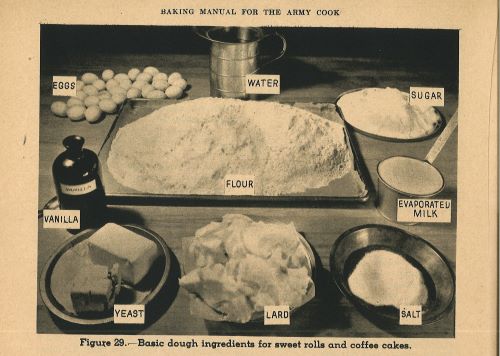
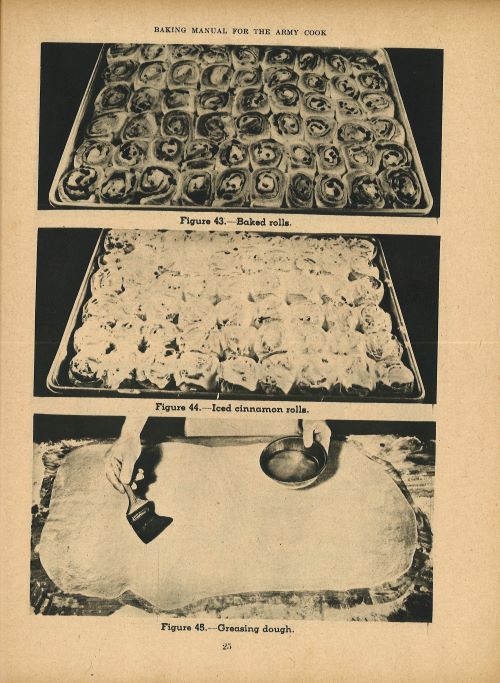
During World War II, Army cooks were provided with technical manuals for general food preparation that instructed them on how to provide basic meals no matter the location. This manual has a different focus. Rather than teaching the basics of food preparation, the Baking Manual for the Army Cook issued by the War Department in October of 1943 introduces more specific skills and recipes, primarily focusing on breads and baked goods. The recipes included are often desserts, and each of the seven recipe sections of the manual contains pictures in black and white of finished products, ingredients, and illustrations of the various steps involved in baking. The manual starts with the basics of baking white, wheat, and rye breads, with an extra note on potato rye bread included at the end. The introduction explains that bread is typically not the duty of the Army kitchen and is usually procured from the post or field bakery instead, but that any Army mess kitchen should be equipped to make breads when needed. The manual moves on quickly to “hot rolls”, including Parker House rolls, sandwich buns, and butter biscuits. The fifth section describes how to make “quick breads” such as biscuits, muffins, cornbread, and griddle cakes. An appendix contains a section on deep fried foods and other baked dishes, including various kinds of croquettes, French-fried tomatoes and carrots, braised kidneys and beef pot-roast. “French-fried potatoes” and potato chips are also discussed, with each recipe serving 100 men. The rest of the manual largely focuses on desserts. Sweet rolls and coffee cakes use one base recipe for a sweet dough with additional instructions for individual recipes, such as sugar twists, doughnuts, and iced cinnamon rolls. Pies also have one base recipe for pie crust, and then numerous recipes for both sweet and savory pies. Most pie and cobbler fillings are fruit based, but there are also recipes for mincemeat pie and custard pies. Cakes have perhaps the most detailed introduction in the entire manual, explaining the importance of every ingredient and the pitfalls most Army bakers will encounter—and how best to remedy them. Cookies and fruit bars follow the same general process for baking with variations, popular recipes including oatmeal cookies, raisin drop cookies, and pecan cookies. Chocolate chip cookies are not mentioned, and in fact chocolate is never mentioned as a baking ingredient for any of the cookie recipes despite appearing as ingredients for cakes and icings.
The Baking Manual for the Army Cook is reflective of war time supplies, even in its ingredients. The introduction at the beginning of the manual spends most of its time discussing lard and its use in the Army kitchen, and although some recipes still mention butter, most use “war lard” as a shortening agent or fat. “War lard” is described as lard that has been “adapted to the requirements of the Army” and developed after research to meet specifications. What those specifications were are not elaborated on.
Recipes provide weight and approximate volume measurements for ingredients, but rather than the usual volume measurements that are used in baking today, the recipes are tailored to tools that are easily available in the Army mess or field kitchen, such as “No. 56 (qt.) dippers” and mess spoons. Each recipe notes how many men can be fed with one recipe or how many items can be produced, all of which are in large batches. One recipe for peach pie filling is enough to fill eighteen 9-inch pies, and the recipe for cornbread is enough to serve 100 men. Eggs are given by weight and volume measurements as well, while still including the number of eggs. One batch of basic dough for sweet rolls calls for 30 eggs or 1 ½ No. 56 (qt.) dippers, and a custard pie filling calls for a total of 70 eggs.
In contrast to basic ingredients like war lard, flour, and salt, there are recipes which contain ingredients like cloves, cinnamon, and vanilla, which were at times more expensive and less widely available. The foods discussed, like pies and cakes, are not things that come to mind when most imagine war-time meals and Army food. The manual is an interesting example of how varying the foods within the US Army were during World War II. The Baking Manual for the Army Cook can be found as part of the Brig. General James E. Baylis and Lt. James E. Bolton Collection (M737) donated to Special Collections by Hugh Bolton. If anyone has questions about the collection or this manual, they can contact Ella Lauderdale at Ella.Lauderdale@usm.edu.
Text by Ella Lauderdale, Assistant Curator for Historical Manuscripts & Archives.