

French WWII Era Gas Mask with Carton Porteur container, 1935 (C.P. 1935 M)
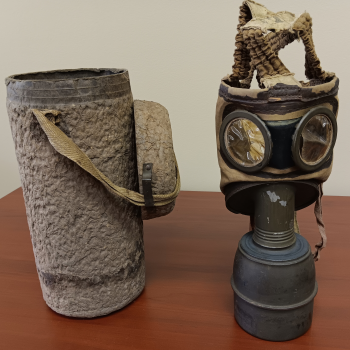
Following World War II, the French supplied gas masks and other military equipment to the Vietnamese National Army, their allies against the Viet Minh in the French Indochina War. The French established the colony of Indochina in 1887, which consisted of present-day Cambodia, Laos, and Vietnam. Control over the colony weakened in World War I, with uprisings fueled by wartime taxation and conscription. Over 90,000 Vietnamese served as laborers or soldiers in France during the war.
While France managed to maintain control of Indochina post-WWI, the second World War loosened its hold on the colony. When France fell to Nazi Germany in 1940, the Vichy regime assumed control of the Indochina provincial government – a situation that persisted even after the regime collapsed in 1944. With France no longer aligned with the Axis powers, Japan launched a surprise attack that drove the French from Indochina shortly before the end of the war in 1945. Following Japan’s surrender that ended WWII, Indochinese protests against the return of French colonial rule quickly led to the French Indochina War. From 1946-1954, French troops and the Vietnamese National Army battled against the Viet Minh, North Vietnamese communist troops led by Ho Chi Minh. France permanently withdrew following the decisive victory of the Viet Minh at the Battle of Dien Bien Phu. The Geneva Accords of 1954 ended the war and divided the country into North and South Vietnam.
Fearful of communist expansion following Mao Zedong’s successful 1949 revolution against its former ally, the Republic of China, the United States had backed France in the French Indochina War. The U.S. declined to sign the Geneva accords and shifted its previous support of the French to the South Vietnamese in the form of military aid and advisory personnel. In 1965, the U.S. began committing combat troops to Vietnam. U.S. troop levels climbed to a height of 536,000 in 1968.
This French gas mask model is characterized by its papier mâché container designed to save metal during WWII. Metal containers were used by combat troops and the papier mâché containers by civilians. Use of gas masks in the French Indochina and Vietnam wars was limited, as gaseous chemical agents were not widely deployed. They were used primarily by U.S. troops, known as Tunnel Rats, who wore them as they cleared enemy tunnels with tear gas. Gas masks did not protect against the liquid chemical defoliant, Agent Orange, that later proved so detrimental to Vietnam veterans.
The gas mask is part of the collection of Donald Farris Deen (1941-1997), who served in Vietnam as a squadron leader in the 101st Airborne “Screaming Eagles” Division of the U.S. Army from 1968-69. The 101st was stationed near the Demilitarized Zone. Their actions were instrumental in countering enemy forces during the Tet Offensive.
Deen returned to Pascagoula after his tour of duty ended in 1969 and made an agreement to purchase Edd’s Drive-In, where he had worked in his teenage years. Edd’s had been a local landmark since the 1950s, known for its chili cheeseburgers and milkshakes. Deen maintained the drive-in’s iconic status until his early death in 1997, which was attributed to years of smoking and exposure to Agent Orange during his service. The popular drive-in remains open, with an additional location in Wade.
The gas mask will be on exhibit at the Center for Military Veterans, Service Members and Families from June 2026-May 2027.
Text by Lorraine Stuart, Head of Special Collections and Curator of Historical Manuscripts and Archives.
SOURCES:
Asia-Pacific Journal. https://apjjf.org/2016/01/5-gunn
Case File, M758 The Donald Farris Deen Collection, Special Collections, University of Southern Mississippi.
National Museum of the United States Army. https://www.thenmusa.org/articles/tunnel-rats-of-the-vietnam-war/
Office of the Historian, U.S. State Department. https://history.state.gov/milestones/1953-1960/dien-bien-phu
Society of Indo-China Philatelists. https://sicp-online.org/icp/issues/Indochina%20and%20World%20War%20I.pdf